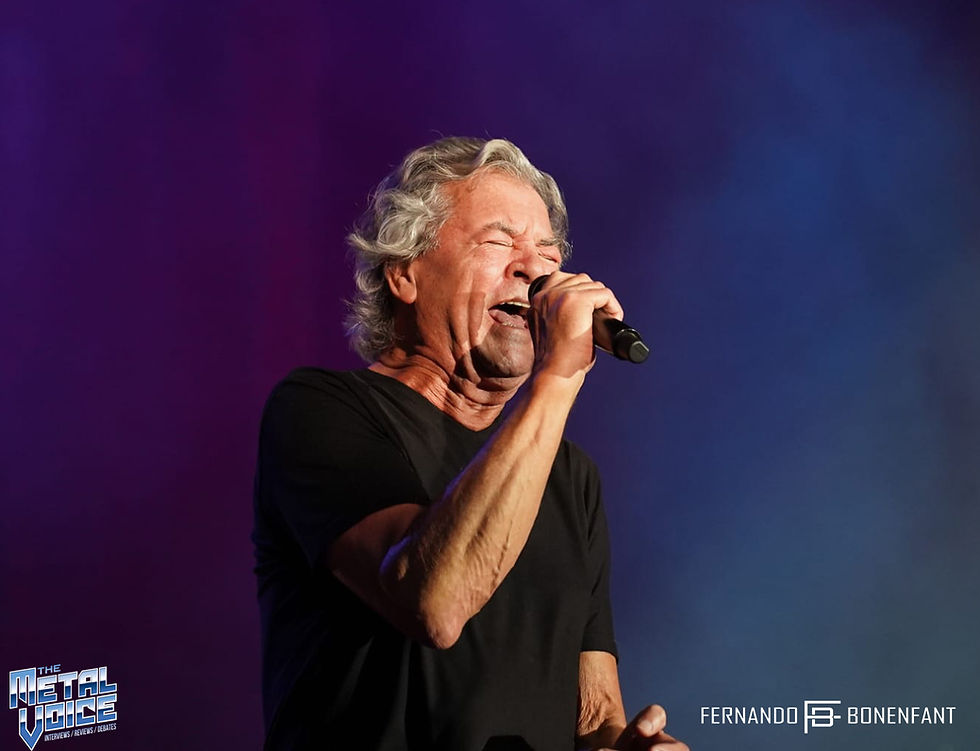


GEOFF TATE On OPERATION: MINDCRIME: “It Was a Love Story Set In a Politically Tumultuous Time”

The former Queensrÿche singer now solo artist GEOFF TATE discusses the final chapter tour performing Operation: Mindcrime in its entirety, the album's controversial recording process, record-company interference, working with producer Peter Collins, his relationship with Montreal, and why the landmark concept album remains relevant today.
ALL PHOTOS BY JIMMY KAY: THE METAL VOICE
Interview conducted, produced and written by Jimmy Kay for The Metal Voice in Montreal, Quebec Nov 7, 2026
Cameras: Orlando Moshpit and Perrin Wolfson
Watch Full Interview here
During a stop in Montreal, The Metal Voice caught up with legendary vocalist Geoff Tate for an extensive conversation about one of the most celebrated concept albums in heavy metal history, Queensrÿche's Operation: Mindcrime.
With Tate currently undertaking what he describes as the farewell tour performing the original album in its entirety, we revisited the record's creation, the pressure surrounding its recording, the initial reaction from the record company, and the unexpected journey that eventually turned it into a landmark release.
Tate also reflected on his complicated years with Queensrÿche, the difference between his current band and his former bandmates, and why Montreal continues to hold a special place in his heart.
Montreal has a long musical history with Geoff Tate, particularly surrounding the development of the characters and the recording of Operation: Mindcrime. But beyond the album, the city itself has clearly left an impression on him.

When Asked what Montreal, Canada means to him, Tate responded:
“It's a city that I kind of fell in love with coming here for the first time. I don't know how to really explain it, but it has an energy and a spirit. It's very creative. The population seems to be very focused on art, which I love. An artistic city is always the best place to be.”
He continued:
“It just has an amazing feel. You feel it here when you come here. It's different and it's unique.”

When asked about his performance (of Montrealers) Leonard Cohen's “Hallelujah” song at the funeral of Ronnie James Dio.
“If you could call it singing, I was crying through most of it. It was a very difficult performance, actually. Very strange. It was a man I loved and respected (Ronnie Jame Dio) and there he is laying behind me through the performance. I honestly couldn't wait for the performance to be over because I was so unable to perform well, at least I felt like I was very unable to. With that kind of emotion, it kind of shuts your voice down, at least for me. They're croaking as I'm singing the notes. I've actually never looked at the performance and listened to it because I just can't bring myself to relive the moment again. But it's what he wanted and Wendy wanted.”
When asked if this is the end of hearing these songs live.
“It's not goodbye as far as performing goes. It's just goodbye on playing this album in its entirety. This tour has been a year and a half already, and it looks like it's going to be finished up in May, so we've got a few months left of it.”

When asked about the contrast between performing live with his present musicians and the Queensrÿche lineup with whom he originally recorded and performed Operation: Mindcrime.
“Whole different feel, whole different band, different personalities. You know, we actually look at each other during the show, which is nice. We engage with each other. It's night and day. All bands, they all work differently, of course. I don't know how bands even barely function because it's really difficult to get four or five people thinking on the same page and operating on the same page. Luckily, we had contracts and things like that to kind of keep us in line and focused. We would have blown apart, I think, years earlier. Thirty good years, and I'm very pleased and proud of the music we've made (Queensryche). I think we made some really great albums and really good songs and had some great times. At first, you're attracted to their abilities, musicianship and that kind of thing. And if they show up on time, you know, it's very important.”
As time goes on, the personalities become clearer."

When asked about the tight recording scheduale of Operation: Mindcrime.
“You can't imagine the pressure trying to produce music with this contract and these deadlines in front of you, tours set up ahead of you, and you have to get it done. There's a lot of stress. There's a lot of stress, and I think that's really what can break a band up, having to perform, having to make it happen no matter what. Like you're sitting there looking at a blank piece of paper going, 'What am I going to say?' But I've got two months. I've got to get it said!”

When asked about its political themes and continuing relevance of the different themes on OPERATION MINDCRIME
“I thought it was a love story. I think it was a love story that was set in a politically tumultuous time. It was a strange time. It kind of similar to today. There was a lot of discord. There was a lot of conservative force, I guess you'd say, politically.”

SUBSCRIBE TO THE METAL VOICE YOUTUBE CHANNEL HERE

EUROPE: TOP 5 ‘MUST HAVE’ ALBUMS
5 DIO Tour Stories: Rock for Ronnie-Wendy Dio, Vinny Appice, Jeff Pilson, Simon Wright & Neil Turbin